
Can you legally ride a motorbike in Vietnam as a tourist? The short answer is: It depends entirely on your home country’s treaty status.
There is a lot of outdated advice online from 2019. This guide explains the strict legal reality as of 2026, enforced by police checkpoints across the country. Whether you are here for a 2-week loop or living as an expat, this is exactly what you need to carry to stay legal.
To see the bigger picture, note that this post is part of our Vietnam Motorcycle Legal Vault, where you can access our full library of legal advice and rider requirements.
Before we dive into the paperwork, watch this breakdown of the most common mistakes travelers make regarding licenses and insurance.
This is the single most important rule for riding in Vietnam. If you remember nothing else from this guide, remember this: Vietnam only recognizes the 1968 Vienna Convention on Road Traffic.
Many travelers assume an “International Driving Permit” is a single, universal document. It is not. There are actually two ‘main’ types of permits used worldwide:
The Hard Truth: If you show a Vietnamese police officer a 1949 IDP, they will treat it as “No License.” It does not matter if your home license is full and valid. In the eyes of Vietnamese law, a 1949 IDP is just a souvenir booklet.
If you hold a license from these countries AND obtain the correct (1968) IDP, you are legally able to ride (provided your home license covers motorcycles):
GB Special Warning for UK Citizens
The UK issues both the 1949 and the 1968 permits. When you ask for your IDP, you must explicitly state that you want a 1968 IDP. If you just ask for “an IDP for Vietnam,” the clerk may mistakenly give you the 1949 version (which many other countires in Asia use). Check the version very carefully before you accept it.
Citizens of these countries cannot currently get a valid IDP for Vietnam because their governments never signed the 1968 treaty.
Pro Tip: If you are from a “Red Light” country, riding a motorbike over 50cc puts you at risk of fines and impoundment. Read our Impound Survival Guide to understand the risks.


Don’t guess—look at your booklet right now.
You can check to see which IDPs each country has signed here.
A common mistake tourists make is pointing to the “Motorcycle Stamp” inside their IDP.
The police in strict zones like Ha Giang and Mui Ne are trained to look at the Year (1968) on the cover first. If the year is wrong, they won’t even open the book to see your stamps. Do not rely on the stamp alone.

Ready for ultimate freedom? Our one-way rentals let you blaze your own trail across Vietnam — no need to loop back!
✅ Pick up/drop off in Hanoi, Danang, or Ho Chi Minh City
✅ Explore Vietnam at your pace
✅ No backtracking—just pure, open-road freedom
You may see websites selling an “International Automobile Association” (IAA) card online for $50-$100.
DO NOT BUY THIS.
The IAA card is a private translation document, not a government-issued permit. Vietnamese police are actively targeting and fining riders who present these cards. It is a waste of money and offers zero legal protection.
1. Ride a 50cc Scooter
You do not need a license to ride a bike under 50cc.
2. Ride Pillion (Guided Tour)
This is the safest and most stress-free way to explore. You sit on the back of a licensed guide’s bike or ride in a support jeep.
3. Get a Vietnamese License (Expats Only)
If you live in Vietnam (Work Permit/Residence Card), you can convert your home car license to a Vietnamese one and take the A1 practical test. This is the “Gold Standard” for legality.

Live here? Ride like you own it. Our long-term expat rentals are made for those working or living in Vietnam.
✅ Cost-effective monthly rates
✅ Flexible contracts, full maintenance support
✅ Ride like a local: Hanoi, Danang, or Ho Chi Minh City

In the past, a traffic stop in Vietnam meant a quick “coffee money” payment of 200,000 VND and a handshake. Those days are over.
As of January 1, 2025, Vietnam has implemented stricter enforcement under the new traffic safety regulations. Police in tourist hotspots (especially Ha Giang, Da Nang, and Mui Ne) are now issuing official tickets with fines that are significantly higher than in previous years.
Here is the official cost of riding illegally. Note that if you do not have a license, you will often be hit with multiple fines at once (e.g., No License + No Insurance + Speeding).
| Violation | 2025 Fine Range (VND) | USD Estimate |
|---|---|---|
| No Driving License (<125cc) (Standard Scooters like Wave, Vision, Airblade) | 2,000,000 – 4,000,000 VND | around $80 – $160 USD |
| No Driving License (>125cc) (Standard Scooters like Wave, Vision, Airblade) | 6,000,000 – 8,000,000 VND | around $240 – $320 USD |
| No “Blue Card” (Registration) | 8,00,000 – 1,000,000 VND | around $32 – $40 USD |
| No Helmet | 400,000 – 6,00,000 VND | around $16 – $25 USD |
The fine is painful, but the impoundment is what ruins holidays.
Under the 2025 crackdown, police now have the authority to confiscate your motorbike for 7 days if you cannot produce a valid license.
The 4,000,000 VND fine is annoying, but a hospital bill could be bankrupting.
Many travelers assume their travel insurance (SafetyWing, World Nomads, Allianz, etc.) covers them because they ticked the “Motorbike” box when buying the policy.
Read the fine print.
Almost every travel insurance policy contains a clause like this:
“Exclusions: Claims arising from the Insured Person being in control of a motor vehicle without a current valid license for driving such vehicle in the country where the accident occurred.”
Translation: If you crash without a 1968 IDP, you are riding illegally. Therefore, your insurance contract is void.
Imagine you are stopped in Ha Giang. You show your 1949 IDP (US/Australian).
Don’t risk it. If you don’t have the 1968 IDP, book a tour with a driver.
If you are living in Vietnam or planning a trip longer than 3 months, getting a local license (GPLX – Giấy Phép Lái Xe) is the gold standard. It makes you 100% legal, fully insurable, and immune to the IDP confusion.
However, this option is not available to tourists on standard E-visas.
To even apply, you must clear the first andministrative hurdle. You need:
Best for: Riders who already have a valid motorbike license at home.
Best for: Riders who already have a valid motorbike license at home.
If your home country license already includes a motorcycle endorsement (e.g., “Class A” or “Motorcycle”), you can skip the tests entirely. This process is called “converting” (đổi bằng lái).
Best for: People who only have a Car license at home but want to ride a motorbike.
If you do not have a motorbike license to convert, you must pass the Vietnamese driving test from scratch. This involves two parts:
1. The Theory Test (The Barrier)
This is where most foreigners fail. The test consists of 25 questions selected from a pool of 200.
The Challenge: The test is usually available only in Vietnamese. Unless you are fluent, you will struggle to pass. Some expats hire “translators” or agencies to help navigate this, but strictness varies by province.
2. The Practical Test (The Figure 8)
If you pass the theory, you proceed to the riding course.
Pro Tip: If you are a long-term resident, check if your country has a specific bilateral treaty with Vietnam (like Sth Korea or Japan). Sometimes this allows for easier conversion rules. For everyone else, “Option A” (getting your home license first and then converting it) is usually the easier thing to do due to the Vietnamese theory test only being in Vietnamese.
Riding in Vietnam is an incredible experience, but the laws are stricter in 2026 than they were a few years ago. Do not rely on “luck” or old forum advice. Check your IDP year, ensure your insurance covers you, and if in doubt—book a tour.
If you are unsure if your specific license works, feel free to Contact Us with a photo of your permit, and we will verify it for you.
Daily
Total
Rider (CRF 300)
$220
Pillion
$120
Damage Waiver
$20
Private Room
$40
Support Vehicle*
$150
* All prices given are in USD and apply per rider except for the support vehicle. The support vehicle is free for groups of 7 or more, otherwise the cost is shared across the group.
Daily
Total
Rider (XR 150)
Rider (CRF 300)
Rider (CB 500X)
Rider (GS 1250)
Pillion
$120
Damage Waiver
$20
Private Room
$40
Support Vehicle*
$150
* All prices given are in USD and apply per rider except for the support vehicle. The support vehicle is free for groups of 7 or more, otherwise the cost is shared across the group.
Daily
Total
Jeep (1 PAX)
$210
Jeep (2 PAX)
$120
Jeep (3 PAX)
$90
Jeep (4+ PAX)
$80
Rider (Easy Rider)
$115
Rider (Self-Drive)
$105
Private Room
$15
* Our jeep tour prices operate on a sliding scale. The larger your group, the less each person pays—each member of your group will pay the lowest daily rate shown. For example, if you have a group of 4 or more, you will each only pay $80/day. All prices are given in USD.
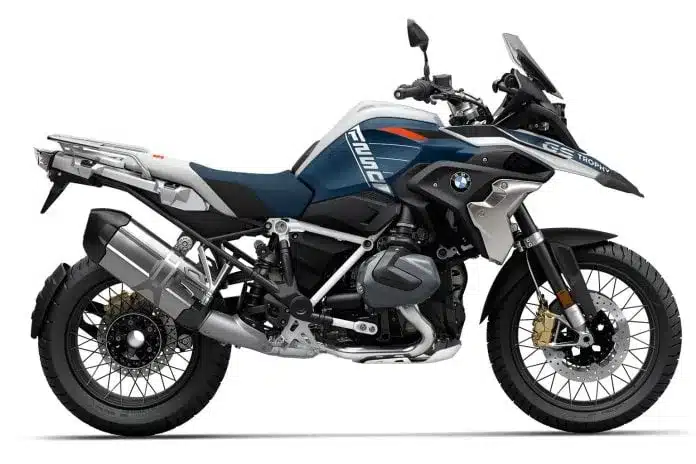
Engine Type
air-liquid cooled, twin cylinder, DOHC, boxer engine
Displacement
1255 cc
Bore X Stroke
102.5 mm x 76 mm
Ignition
FI
Fuel System
fuel injection
Compression Ratio
12.5:1
Starter
electric
Gearbox
6-speed
Front Suspension
BMW Motorrad Telelever; stanchion diameter 37 mm
Rear Suspension
single-sided swing arm with BMW Motorrad Paralever
Front Brakes
dual disc brake, floating brake discs, diameter 305 mm, 4-piston radial calipers
Rear Brakes
single disc brake, diameter 276 mm, double-piston floating caliper
Front Tyres
120/70 R19
Rear Tyres
170/60 R17
Wheelbase
1514 mm
Seat Height
850 mm
Ground Clearance
790 mm
Kerb Weight
249 kg
Fuel Capacity
20 litres
Dimensions
2207 mm (L) x 952.5mm (W) x 1430 mm (H)

Engine Type
air cooled, OHC, single cylinder
Displacement
149 cc
Bore X Stroke
57.3 mm x 57.8 mm
Ignition
CDI
Fuel System
20 mm piston valve carburettor
Compression Ratio
9.5:1
Starter
electric with kick starter backup
Gearbox
5-speed
Front Suspension
telescopic fork, 180 mm axle travel
Rear Suspension
single shock swing arm, 150 mm axle travel
Front Brakes
dual piston caliper, 240 mm disc
Rear Brakes
mechanical drum
Front Tyres
90/90 19
Rear Tyres
110/90 17
Wheelbase
1362 mm
Seat Height
825 mm
Ground Clearance
243 mm
Kerb Weight
129 kg
Fuel Capacity
12 litres
Dimensions
2091 mm (L) x 811 mm (W) x 1125 mm (H)

Engine Type
liquid cooled parallel-twin four stroke
Displacement
470 cc
Bore X Stroke
67 mm x 66.8 mm
Ignition
PGMI – FI
Fuel System
fuel injection
Compression Ratio
10.7:1
Starter
electric
Gearbox
6-speed
Front Suspension
41 mm SFF-BP USD Forks
Rear Suspension
Prolink Mono with 5 stage pre load adjuster
Front Brakes
dual 296 mm discs with 4 piston calipers; ABS
Rear Brakes
240 mm disc; ABS
Front Tyres
110/80R19M/C (59H)
Rear Tyres
160/60R17M/C
Wheelbase
1445 mm
Seat Height
830 mm
Ground Clearance
180 mm
Kerb Weight
199 kg
Fuel Capacity
17.7 litres
Dimensions
2,155 mm (L) x 830 mm (W) x 1,410 mm (H)

Engine Type
single cylinder, DOHC, liquid cooled
Displacement
286 cc
Bore X Stroke
76 mm x 63 mm
Ignition
Full Transistor Digital
Fuel System
PGM-FI electronic fuel injection
Compression Ratio
10.7:1
Starter
electric
Gearbox
5-speed
Front Suspension
43 mm telescopic upside down
Rear Suspension
Prolink Mono with 5 stage pre load adjuster
Front Brakes
Rear Brakes
220 mm disc, single piston caliper
Front Tyres
80/100 21
Rear Tyres
120/80 18
Wheelbase
1455 mm
Seat Height
880 mm
Ground Clearance
285 mm
Kerb Weight
142 kg
Fuel Capacity
7.8 litres
Dimensions
2230 mm (L) x 820 mm (W) x 1200 mm (H)