

Riding in the rain is easy. You put on a raincoat, you slow down, you arrive wet.
Riding in “Nom” weather is a different beast entirely.
Every year between February and April, Northern Vietnam experiences a unique meteorological phenomenon. The humidity rises to near 100%, but it often doesn’t “rain” in the traditional sense. Instead, the moisture in the air condenses on every cold surface it touches.
Walls sweat. Windows drip. And most dangerously for us: the roads become permanently greasy.
If you are booking a trip for the weeks after Tet, you need to prepare for the damp. Here is your survival guide to the wettest months of the year. This guide covers the specific “Nom” phenomenon. For a full calendar of riding seasons across the country, check out The Motorcyclist’s Guide to Vietnam’s Weather.
To see the bigger picture, note that this post is part of our Vietnam Motorcycle Legal Vault, where you can access our full library of legal advice and rider requirements.

“Trời Nồm” (Nom Sky) occurs when weak cold air from China clashes with warm, moist air from the Southeast Sea. The result is saturation.
The air holds more water than it can handle, so it dumps it on everything.

This is the biggest danger for motorcyclists. When it rains heavily, the water washes dirt and oil off the road. But during Nom, the mist is too light to wash the road clean.
Instead, the moisture mixes with the dust, oil, and exhaust fumes on the tarmac to create a thin, slime-like layer.
During Nom, the air outside your helmet is 100% humid and cold. The air inside your helmet is hot and moist from your breath.
The result? Instant blindness.

Because the air is saturated, nothing dries. If you get your gloves wet on Day 1, they will likely still be wet on Day 5.
Pack all your clean clothes inside Ziploc bags inside your backpack. This is the only way to keep them crisp.

Can you ride away from the Nom? Yes, but you need to go high or go South.
Planning a route to escape the weather? See our One-Way Rentals.
The Nom season gives the Vietnamese mountains a mystical, ancient look that you don’t get in the summer.
Just make sure you have the right gear. Book a bike today.
Daily
Total
Rider (CRF 300)
$220
Pillion
$120
Damage Waiver
$20
Private Room
$40
Support Vehicle*
$150
* All prices given are in USD and apply per rider except for the support vehicle. The support vehicle is free for groups of 7 or more, otherwise the cost is shared across the group.
Daily
Total
Rider (XR 150)
Rider (CRF 300)
Rider (CB 500X)
Rider (GS 1250)
Pillion
$120
Damage Waiver
$20
Private Room
$40
Support Vehicle*
$150
* All prices given are in USD and apply per rider except for the support vehicle. The support vehicle is free for groups of 7 or more, otherwise the cost is shared across the group.
Daily
Total
Jeep (1 PAX)
$210
Jeep (2 PAX)
$120
Jeep (3 PAX)
$90
Jeep (4+ PAX)
$80
Rider (Easy Rider)
$115
Rider (Self-Drive)
$105
Private Room
$15
* Our jeep tour prices operate on a sliding scale. The larger your group, the less each person pays—each member of your group will pay the lowest daily rate shown. For example, if you have a group of 4 or more, you will each only pay $80/day. All prices are given in USD.
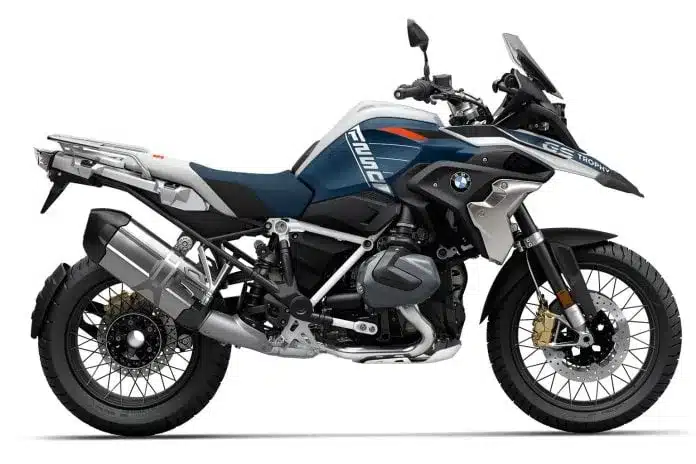
Engine Type
air-liquid cooled, twin cylinder, DOHC, boxer engine
Displacement
1255 cc
Bore X Stroke
102.5 mm x 76 mm
Ignition
FI
Fuel System
fuel injection
Compression Ratio
12.5:1
Starter
electric
Gearbox
6-speed
Front Suspension
BMW Motorrad Telelever; stanchion diameter 37 mm
Rear Suspension
single-sided swing arm with BMW Motorrad Paralever
Front Brakes
dual disc brake, floating brake discs, diameter 305 mm, 4-piston radial calipers
Rear Brakes
single disc brake, diameter 276 mm, double-piston floating caliper
Front Tyres
120/70 R19
Rear Tyres
170/60 R17
Wheelbase
1514 mm
Seat Height
850 mm
Ground Clearance
790 mm
Kerb Weight
249 kg
Fuel Capacity
20 litres
Dimensions
2207 mm (L) x 952.5mm (W) x 1430 mm (H)

Engine Type
air cooled, OHC, single cylinder
Displacement
149 cc
Bore X Stroke
57.3 mm x 57.8 mm
Ignition
CDI
Fuel System
20 mm piston valve carburettor
Compression Ratio
9.5:1
Starter
electric with kick starter backup
Gearbox
5-speed
Front Suspension
telescopic fork, 180 mm axle travel
Rear Suspension
single shock swing arm, 150 mm axle travel
Front Brakes
dual piston caliper, 240 mm disc
Rear Brakes
mechanical drum
Front Tyres
90/90 19
Rear Tyres
110/90 17
Wheelbase
1362 mm
Seat Height
825 mm
Ground Clearance
243 mm
Kerb Weight
129 kg
Fuel Capacity
12 litres
Dimensions
2091 mm (L) x 811 mm (W) x 1125 mm (H)

Engine Type
liquid cooled parallel-twin four stroke
Displacement
470 cc
Bore X Stroke
67 mm x 66.8 mm
Ignition
PGMI – FI
Fuel System
fuel injection
Compression Ratio
10.7:1
Starter
electric
Gearbox
6-speed
Front Suspension
41 mm SFF-BP USD Forks
Rear Suspension
Prolink Mono with 5 stage pre load adjuster
Front Brakes
dual 296 mm discs with 4 piston calipers; ABS
Rear Brakes
240 mm disc; ABS
Front Tyres
110/80R19M/C (59H)
Rear Tyres
160/60R17M/C
Wheelbase
1445 mm
Seat Height
830 mm
Ground Clearance
180 mm
Kerb Weight
199 kg
Fuel Capacity
17.7 litres
Dimensions
2,155 mm (L) x 830 mm (W) x 1,410 mm (H)

Engine Type
single cylinder, DOHC, liquid cooled
Displacement
286 cc
Bore X Stroke
76 mm x 63 mm
Ignition
Full Transistor Digital
Fuel System
PGM-FI electronic fuel injection
Compression Ratio
10.7:1
Starter
electric
Gearbox
5-speed
Front Suspension
43 mm telescopic upside down
Rear Suspension
Prolink Mono with 5 stage pre load adjuster
Front Brakes
Rear Brakes
220 mm disc, single piston caliper
Front Tyres
80/100 21
Rear Tyres
120/80 18
Wheelbase
1455 mm
Seat Height
880 mm
Ground Clearance
285 mm
Kerb Weight
142 kg
Fuel Capacity
7.8 litres
Dimensions
2230 mm (L) x 820 mm (W) x 1200 mm (H)
Daily
Total
Rider (CRF 300)
$200
Pillion
$120
Damage Waiver
$20
Private Room
$40
Support Vehicle*
$150
* All prices given are in USD and apply per rider except for the support vehicle. The support vehicle is free for groups of 7 or more, otherwise the cost is shared across the group.