I’ve been running motorcycle tours in Northern Vietnam for years, and if I had a dollar for every time a rider told me, “I thought I could do 400km in a day,” or “The rental guy said this license was fine,” I’d have retired to a beach in Da Nang by now.
As a tour operator, I spend my life mapping the tarmac and dirt that Google Maps often forgets. I’ve seen the best of this country, but I’ve also seen the trips that ended in disaster because of bad planning or bad advice.
Here are my confessions: the routes we usually keep to ourselves, and the hard truths about riding here that most brochures won’t tell you.
When a client asks for “The Loop,” I usually gently steer them toward the alternatives. Northern Vietnam is comprised of the Northeast and the Northwest. The Northwest is the rugged, dramatic sibling to the Northeast’s popular loops, offering bigger mountains and technical single-track.
Hoang Su Phi: The Golden Stairway
While Sapa gets the fame (and the crowds), Hoang Su Phi holds the soul of the rice harvest.
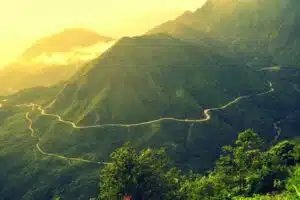
The Secret: The riding here isn’t wide tarmac. It consists of endless ribbons of concrete single-track that snake up near-vertical mountainsides.
Insider Tip: The Micro-Climate Miracle. Don’t be discouraged if you arrive and see a valley of brown, harvested stubble. The mountains here create distinct micro-climates, meaning the harvest is never uniform. You can ride out of a harvested valley, turn a sharp corner, and suddenly drop into a bowl that is still lush green or perfectly golden. The scenery changes as fast as the gears.
Xi Ma Cai: The Frontier with China
Xi Ma Cai is a blank spot on most tourist maps, hovering near the Chinese border north of Bac Ha.
The Secret: The geography here is mind-bending. We are talking about colossal, deep river valleys that slice through the earth, offering uninterrupted views right over into China. It is vast, intimidating, and beautiful.
Insider Tip: Market Day is Every Day. While most tourists only know the Sunday Bac Ha market, Xi Ma Cai and the surrounding communes are a hub for authentic ethnic trade. Because the region is so dense with different ethnic minorities, you can find a bustling, colorful market almost any day of the week if you know where to look. It’s vibrant, loud, and completely devoid of souvenir stalls.
Tua Chua: The Forgotten Plateau
Everyone knows the Dong Van Karst Plateau, but few have heard of Tua Chua in Dien Bien province.
The Secret: This is arguably the most isolated you can get on a bike in the North. It is a mysterious land of black rock, ancient Shan Tuyet tea trees, and Hmong culture that has remained virtually unchanged for a century.
Insider Tip: The “Foreigner” Factor. Tua Chua is so off the radar that seeing a Western foreigner is still a genuine event for the locals. You aren’t just a tourist here; you are a curiosity. It is extremely rare for independent travelers to make it this far, meaning you get an unfiltered welcome that has vanished from the more commercialized loops.
Cao Bang: The Jurassic Park Route
In the Northeast, most riders blast down highway 3 to reach Ban Gioc Waterfall, take a selfie, and leave. They miss the best part.
The Secret: While the Northwest is about vertical height and deep chasms, Cao Bang offers a surreal landscape of limestone pillars rising abruptly from flat rice paddies and rivers. It looks less like Vietnam and more like a movie set.
Insider Tip: The Phong Nam Detour. There is a valley called Phong Nam that sits right on the border line. It is a dead-end road, meaning the tour buses never go there. You ride along the Quay Son river, flanked by massive karsts, in total silence. It is, without a doubt, the most photogenic 10km stretch in the entire Northeast, yet 99% of tourists miss it.

The Pain Point: In Europe or the US, a 400km day is a nice cruise. In Northern Vietnam, 400km is a suicide mission.
The Reality: The average speed in the mountains is 35-40km/h. That’s it. Between buffalo on the road, trucks cutting corners, road construction, and the sheer technicality of the curves, you cannot rush.
The Insider Tip: Cap it at 180km average per day over the tour. When we plan tours, we rarely exceed 200km in a day. Why? Because you need time to stop, take photos, drink coffee, and actually fix the flat tire you will eventually get. You didn’t come here to watch your friend’s rear wheel nor follow the Google route. If your itinerary says 300km+ per day, tear it up and start again.
The Pain Point: This is the single biggest lie told to tourists. Rental shops will often say, “No license? No problem.” It is a problem.
The Reality: Police checkpoints are increasing, and they are strict.
The Insider Tip: The Paperwork Specifics.
You need an IDP NOT an IDL: International Driving Licenses are not accepted in Vietnam no matter what the person who sold or issued it to you said. If you have an IDL, you will get fined. Period.
1968 vs. 1949: If you are from the West (UK, EU, USA, Aus), check your IDP. Vietnam is a signatory to the 1968 Vienna Convention. If your IDP says “1949 Geneva Convention” on the front, it is legally worthless here. You are riding unlicensed.
The ASEAN Exception: If you hold a license from an ASEAN country (like Thailand, Malaysia, or Singapore etc…), you are legally allowed to ride in Vietnam provided your license has English text on it.
The “Argument” Insurance: However, here is the reality check: Not every rural traffic cop is up to date on ASEAN trade agreements. Even if you have a valid ASEAN license, we strongly advise getting an IDP anyway. It is much easier to hand over a recognized international booklet than to try and debate international treaty law on the side of the road with a policeman who only speaks a little English. Note to Millenials: Google translate isn’t gonna cut it either.
Digital is Dead: Do not rely on showing a police officer a PDF on your phone. Yes, some may accept it, but the legal reality is they require the original hard copy booklet and can fine you for not having it.

The Pain Point: You’ll see “Honda Wins” for sale or rent for $250 everywhere.
The Reality: Let’s be clear—Honda hasn’t made these bikes in decades. These are Chinese copies, often held together by rust and optimism.
The Insider Tip: The Mechanic Lottery. The defenders of these bikes will tell you, “They are easy to fix!” And they are right. Any village mechanic can fix them with a hammer and a wrench. But here is the catch: you will be visiting those mechanics constantly.
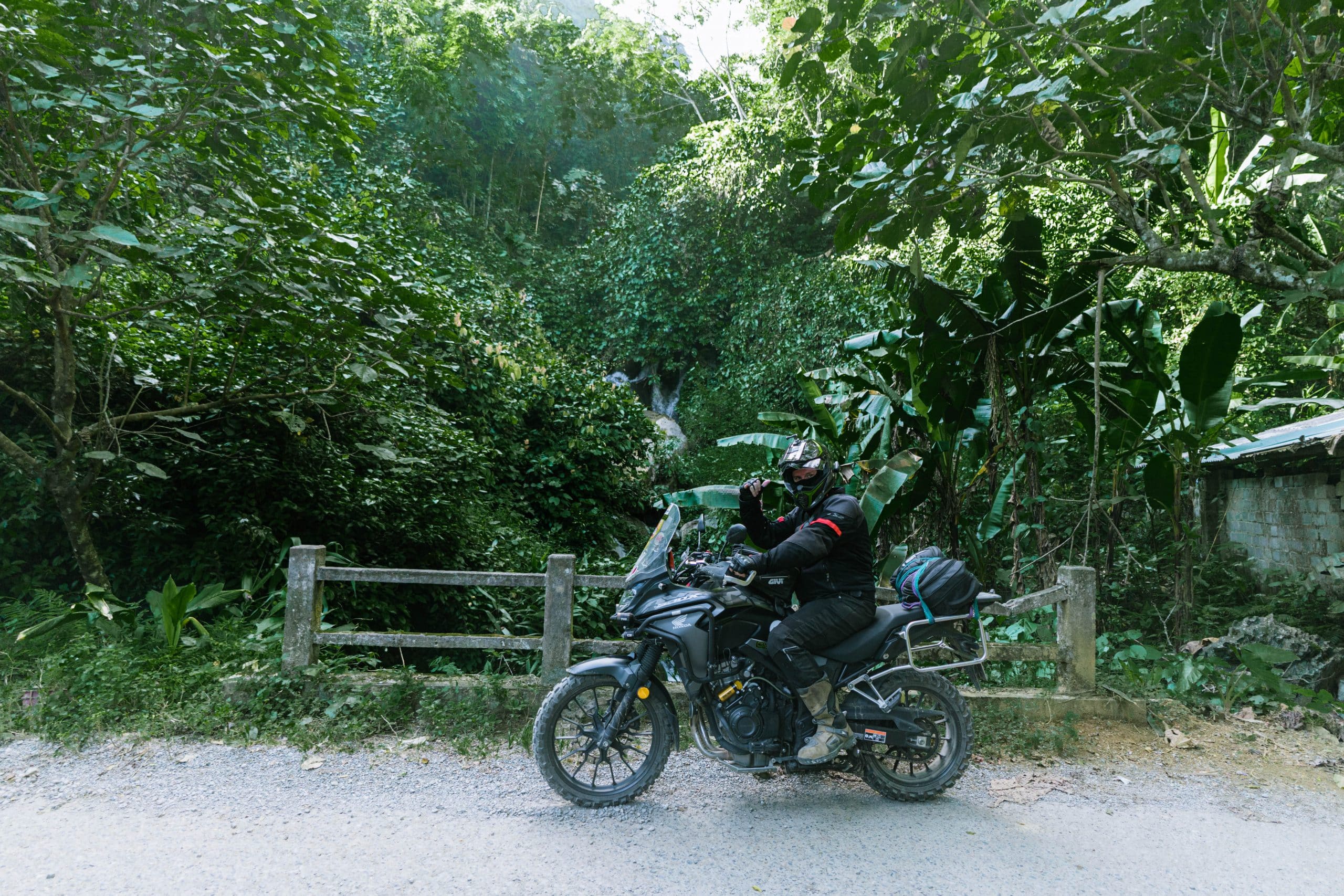
Do you want to spend your holiday riding the mountains, or sitting by the side of the road waiting for a clutch cable to be replaced for the third time? We ride exclusively on genuine Honda XR150s, CRF250s, CRF300s and CB500xs because reliability allows you to focus on the adventure, not the repair bill.
The Pain Point: Trusting the “Blue Line.”
The Reality: Google Maps algorithms prioritize distance and ease of travel, not road quality. It will happily route you down a “highway” that is actually a muddy buffalo track or a river crossing that washes away during the rainy season. Also, Google is not as interested in updating data on northern Vietnam as it is in London, Rome, Paris etc… go figure.
The Insider Tip: The Concrete Ribbon. Some of the best roads in Hoang Su Phi aren’t even yellow lines on Google; they are thin white lines or not there at all. This is where local knowledge is irreplaceable. We know which bridge is out, and which shortcut is actually a dead end.

The Pain Point: Rigid “cookie-cutter” tours that force you to ride from A to B regardless of the reality on the ground. These are companies and guides that are more interested in in churning out tours than offering a unique experience based on rider interest and ability.
The Reality: In all my years operating here, I have never ridden from Point A to Point B the exact same way twice.
The Insider Tip: The Morning Briefing. We choose our specific route on the morning of the ride, not six months in advance. Why? Because Vietnam is dynamic.
We judge the weather: Did it rain heavily last night? If so, that clay shortcut I love is now an ice rink, so we divert.
We judge the group: Is the group feeling strong and hungry for technical dirt? Or was it a late night with the local rice wine, meaning we should take the scenic, flowy tarmac option?
We judge the bike: Are we on agile CRF300s or heavier ADV builds?
This is why even our “stock” tours are effectively bespoke. We don’t force you down a track just because a PDF says so; we pick the path that fits the rider, the machine, and the mountain on that specific day.
Vietnam is not a place to just “wing it” if you want the ride of a lifetime—especially if you are venturing into the wild frontiers of Tua Chua or Xi Ma Cai.
You can ride the tourist loop, dodge the buses, and hope your 1949 IDP doesn’t get checked. Or, you can listen to the confessions of those who live here: get the right bike, get the right paperwork, and take the trails that don’t have names yet.
Ready to discover the Vietnam most tourists miss? Drop us a line at Rentabike Vietnam, and let’s plan a ride.
Daily
Total
Rider (CRF 300)
$220
Pillion
$120
Damage Waiver
$20
Private Room
$40
Support Vehicle*
$150
* All prices given are in USD and apply per rider except for the support vehicle. The support vehicle is free for groups of 7 or more, otherwise the cost is shared across the group.
Daily
Total
Rider (XR 150)
Rider (CRF 300)
Rider (CB 500X)
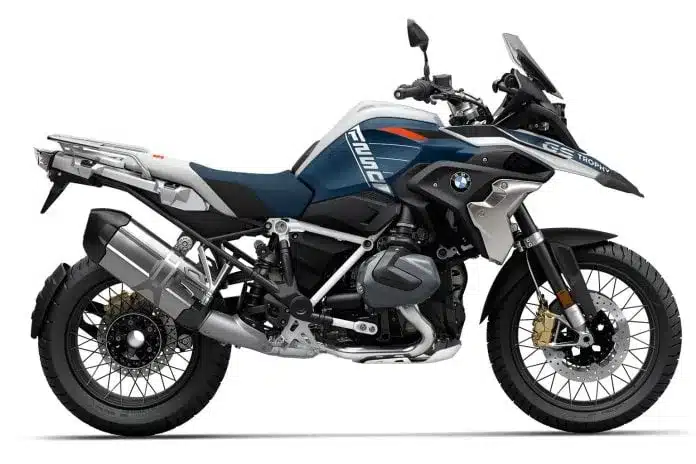
Rider (GS 1250)
Pillion
$120
Damage Waiver
$20
Private Room
$40
Support Vehicle*
$150
* All prices given are in USD and apply per rider except for the support vehicle. The support vehicle is free for groups of 7 or more, otherwise the cost is shared across the group.
Daily
Total
Jeep (1 PAX)
$210
Jeep (2 PAX)
$120
Jeep (3 PAX)
$90
Jeep (4+ PAX)
$80
Rider (Easy Rider)
$115
Rider (Self-Drive)
$105
Private Room
$15
* Our jeep tour prices operate on a sliding scale. The larger your group, the less each person pays—each member of your group will pay the lowest daily rate shown. For example, if you have a group of 4 or more, you will each only pay $80/day. All prices are given in USD.
Engine Type
air-liquid cooled, twin cylinder, DOHC, boxer engine
Displacement
1255 cc
Bore X Stroke
102.5 mm x 76 mm
Ignition
FI
Fuel System
fuel injection
Compression Ratio
12.5:1
Starter
electric
Gearbox
6-speed
Front Suspension
BMW Motorrad Telelever; stanchion diameter 37 mm
Rear Suspension
single-sided swing arm with BMW Motorrad Paralever
Front Brakes
dual disc brake, floating brake discs, diameter 305 mm, 4-piston radial calipers
Rear Brakes
single disc brake, diameter 276 mm, double-piston floating caliper
Front Tyres
120/70 R19
Rear Tyres
170/60 R17
Wheelbase
1514 mm
Seat Height
850 mm
Ground Clearance
790 mm
Kerb Weight
249 kg
Fuel Capacity
20 litres
Dimensions
2207 mm (L) x 952.5mm (W) x 1430 mm (H)

Engine Type
air cooled, OHC, single cylinder
Displacement
149 cc
Bore X Stroke
57.3 mm x 57.8 mm
Ignition
CDI
Fuel System
20 mm piston valve carburettor
Compression Ratio
9.5:1
Starter
electric with kick starter backup
Gearbox
5-speed
Front Suspension
telescopic fork, 180 mm axle travel
Rear Suspension
single shock swing arm, 150 mm axle travel
Front Brakes
dual piston caliper, 240 mm disc
Rear Brakes
mechanical drum
Front Tyres
90/90 19
Rear Tyres
110/90 17
Wheelbase
1362 mm
Seat Height
825 mm
Ground Clearance
243 mm
Kerb Weight
129 kg
Fuel Capacity
12 litres
Dimensions
2091 mm (L) x 811 mm (W) x 1125 mm (H)

Engine Type
liquid cooled parallel-twin four stroke
Displacement
470 cc
Bore X Stroke
67 mm x 66.8 mm
Ignition
PGMI – FI
Fuel System
fuel injection
Compression Ratio
10.7:1
Starter
electric
Gearbox
6-speed
Front Suspension
41 mm SFF-BP USD Forks
Rear Suspension
Prolink Mono with 5 stage pre load adjuster
Front Brakes
dual 296 mm discs with 4 piston calipers; ABS
Rear Brakes
240 mm disc; ABS
Front Tyres
110/80R19M/C (59H)
Rear Tyres
160/60R17M/C
Wheelbase
1445 mm
Seat Height
830 mm
Ground Clearance
180 mm
Kerb Weight
199 kg
Fuel Capacity
17.7 litres
Dimensions
2,155 mm (L) x 830 mm (W) x 1,410 mm (H)

Engine Type
single cylinder, DOHC, liquid cooled
Displacement
286 cc
Bore X Stroke
76 mm x 63 mm
Ignition
Full Transistor Digital
Fuel System
PGM-FI electronic fuel injection
Compression Ratio
10.7:1
Starter
electric
Gearbox
5-speed
Front Suspension
43 mm telescopic upside down
Rear Suspension
Prolink Mono with 5 stage pre load adjuster
Front Brakes
Rear Brakes
220 mm disc, single piston caliper
Front Tyres
80/100 21
Rear Tyres
120/80 18
Wheelbase
1455 mm
Seat Height
880 mm
Ground Clearance
285 mm
Kerb Weight
142 kg
Fuel Capacity
7.8 litres
Dimensions
2230 mm (L) x 820 mm (W) x 1200 mm (H)